LGBTQ+ health services provided by Dr. Robert Kelly at his Exeter clinic

[ad_1]
Exeter — Members of the LGBTQ+ community have specific medical concerns and often find it difficult to access providers that meet their needs on the shore.
Many patients, especially teenagers and their parents, had to go to large hospitals in cities like Boston to get the care they needed.
This lack of care became painfully apparent during the coronavirus pandemic, and local medical groups recently began grappling with the challenge of reaching this underserved community.
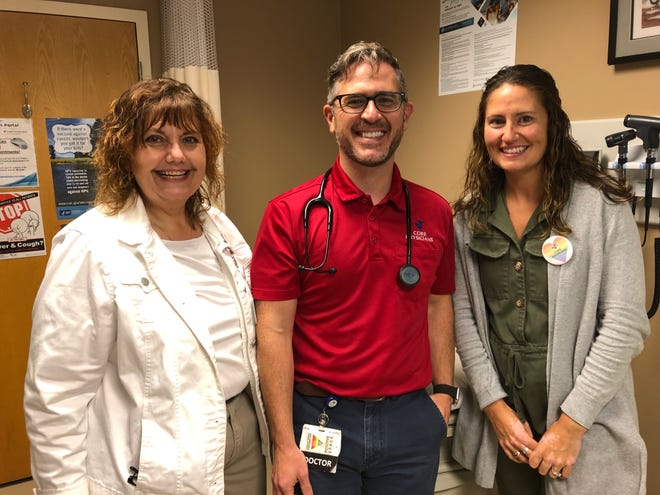
Core Physicians Dr. Robert Kelly and several colleagues are working on this problem at a more accessible clinic at 21 Hampton Road.

Mr. Kelly examined local primary care practices and found that they were reluctant or unwilling to be involved in treating the needs of LGBTQ patients. and began hiring medical consultants as needed.
“I started moving into gender-affirming care because I need this here,” Kelly said.
more:Portsmouth Pride: LGBTQ+ community fears loss of abortion rights may be ‘only the beginning’
He added that he felt ready to take on the work he needed, including one centered around teaching.
“I started out in consulting work, but the practice evolved from there,” he said.
Importance of local LGBTQ+ healthcare practices
How important is it to the medical community to provide specialized care for this population?
“New Hampshire hospitals and their healthcare providers play a vital role in improving the health and equity of all patients,” said Steve Arnen, president of the New Hampshire Hospital Association. We are extremely proud of the safe and supportive environment our providers have created to support the health and well-being of all and absolutely support the LGBTQ+ community and the clinicians who provide their care. .”
People in the LGBTQ+ community say finding a provider that understands their needs is very important.
Parana Belkin, a Rochester resident, said, “I was lucky to find a primary care doctor who was good with my transgender patients, but it was word of mouth and he did nothing to promote himself. “I’ve been lucky. It’s not uncommon to hear stories of people traveling a few hours from New Hampshire to access transcompetent health care in Boston. Planned Parenthood, Equality Health Center, Lovering.” Clinics such as Health are all doing a great job offering hormone replacement therapy and sexual health services, but LGBTQ people deserve compassionate primary care too.”
Gerri Cannon is the State Representative for Somersworth and a member of the Somersworth School Board. She recently underwent gender reassignment surgery.
“The best thing to do is have a medical practice that understands the needs of transgender people,” she said. But I had to make sure they knew my medical history and my future plans like surgery.”
more:History-making NH MP Jerry Cannon on why gender confirmation surgery was right for her
Cannon said it remains difficult to find a local surgeon who can perform gender-confirming surgery.
“I had to go to Boston,” said Cannon. “A friend of mine has taken a trip to Dartmouth Hitchcock. Working with transgender-savvy surgeons and staff is incredibly uplifting. We often hear stories of male-to-male patients looking for a surgeon who is versed in upper or lower surgery, and male-to-female patients looking for a vaginoplasty.” No surgical team. ”
Services Provided in Gender Affirming Care
What is Gender Affirming Care?
As defined by the World Health Organization, “gender-affirmative health care includes social, psychological, behavioral or medical interventions (such as hormone therapy or (including surgery), either alone or in combination.”
Dr. Kelly deals with adults, not children, in her gender affirmation practice. As a family doctor, Kelly said he treats people from birth to death and that includes all populations.
Ms Kelly said the focus of gender care so far has been mainly on prevention.
“HIV? Take a pill to prevent it,” he said. “Otherwise, patients are referred to an infectious disease doctor or other specialist, which comes at a much higher cost and out-of-pocket cost because there is not much care available.”
more:Standing Together exhibit sheds light on NH LGBTQ+ activism
Some gay people simply want peace of mind and knowing they can have safe sex, Kelly said.
One treatment for gay men is PrEP (pre-exposure prophylaxis). The use of antiretroviral drugs to prevent HIV infection. PrEP is used for HIV-uninfected people who can acquire HIV through sexual activity or injecting drugs.
According to the CDC (Centers for Disease Control and Prevention), the US Food and Drug Administration has approved three drugs for use as PrEP. Two combine the drugs in one oral tablet taken daily. The third drug is a drug that is given as an injection every two months.
Kelly also sees patients with gender dysphoria. He said counseling is used to help patients better understand the condition. rice field.
Consultant treats physical characteristics
Physical characteristics are those that accompany gender-affirming patients.
“I have a consultant colleague who handles the tops and bottoms,” he said. “We do hormone therapy and holistic behavioral therapy. We do gender-differentiated care and surgical referrals. We work closely with local providers.”
The top and bottom can be defined as the top to handle breast removal or augmentation as required. The lower part includes the genitalia that the patient feels unsuitable for the identified person.
A colleague, Dr. Kimberly Marble, is a plastic surgeon who has done a lot of work with breast cancer patients and performs “top” surgeries for Kelly’s patients.

“She removes or adds breast tissue as needed,” Kelly said.
Kimberly Marble, M.D., of the Core Physicians Practice in Orthopedic Surgery, Marble said she offers several services to the LGBTQ+ population.
“I do all forms of upper surgery, including FTM (female to male), MTF (male to female), and non-binary,” said Dr. Marble. “In addition to laser hair removal, we also offer free makeup consultations and skin care consultations on general skin health, anti-aging, and treating acne that may occur when taking testosterone.”
Dr. Evelyne Caron of Core Obstetrics and Gynecology performs “butt” surgery.

“She’s skilled in transgender medicine,” Kelly said. “She will have a sex-reassigning hysterectomy if she wants it.
“I work with transgender female-to-male patients,” she said. A hysterectomy is performed for a variety of reasons, including cancer.A man trapped in a woman’s body may wish to have his uterus and ovaries removed.Some patients who consider themselves gender neutral may want their ovaries removed. Some people don’t mind leaving them, but they remove the fallopian tubes so they don’t get pregnant.
Caron says that those who want surgery have to live as men for about 12 months to make sure it’s the right decision for them.
“I am the last step,” Karon said. “They will work with Dr. Marble for top surgery first. We work through hormones. These are people who are uncomfortable with the body they are in.”
Caron said she sees more of this type of patient than before.
“This is more accepted now,” she said. “The more acceptance, the more services will follow.”
Continuing education to serve the LGBTQ+ community
Tracie Baird is the clinical supervisor of four core practices in Hampton Roads. She said she loves her work done at Kelly’s office and she’s proud to be a part of it.

“I do a lot of training with my staff,” Baird said. “I also help with gender-affirming treatments like hormone injections. Some we can teach and patients do at home, others have to be done in the office.”
Baird said she works a lot with young adult parents. She also helps with insurance claims and acts as a liaison with clinics that refer patients to Kelly.
“I’m talking to my parents that this can be difficult,” Baird said. “We talk about pronouns that the person might like, names they would like to be called. We help foster better understanding between family members. They haven’t done anything wrong. Tell them this is your child.
Kelly addresses all patient concerns.
“Now I’m answering a lot of questions about monkeypox,” Kelly said. I’ve been asked about the vaccine by dozens of patients and there’s one available but New Hampshire is in a state of flux…not enough and there’s no mechanism to distribute it so we can’t control it The FDA is about to approve emergency use authorization using smaller doses, as it did with the COVID vaccine.
more:NH DHHS expands monkeypox vaccine eligibility and vaccination sites
“Now I mostly see patients one day a week, ages 11 to 80,” he said. “This is just part of my practice, but I am happy to provide care.”
Exeter Health Resources Recognized for Improving LGBTQ+ Care
In 2019, the NH Foundation for Healthy Communities presented Exeter Health Resources with the Noah Lord Patient & Family Involvement Award to honor the work done by the LGBTQ+ Advisory Board to improve the design and delivery of care for patients in the LGBTQ+ community. was awarded.
Over the past few months, the Advisory Board has been committed to promoting a welcoming and gender-inclusive culture throughout the healthcare system. They have worked to update the organization’s website to include information about these service offerings and reflect gender-inclusive language and pictures.
Other significant achievements include removing the words “male” and “female” from patient wristbands at the hospital, changing all single-stall bathrooms at Exeter Hospital to be gender neutral, and encouraging staff to continue provided a good education.
Kelly recently podcasted his practice on Sg2 Perspectives. For more information, please visit https://sg2.podbean.com/e/exeter-health-resources-lgbtq-health-program-an-interview-with-dr-robert-kelly/.
In addition to treating LGBTQ patients, Kelly provides addiction services, including medical assisted treatment, another area New Hampshire feels there are not enough practitioners.
[ad_2]
Source link