Goevry Uk

Top Menu

  • DMCA
  • Privacy Policy
  • Contacts
  • US
  • DE

Main Menu

  • Travel & Lifestyle
  • Fashion
  • Health & Beauty
  • Science & Tech
  • Gift Guides
  • Buying Guides
  • DMCA
  • Privacy Policy
  • Contacts
  • US
  • DE

logo

Header Banner

Goevry Uk

  • Travel & Lifestyle
    • Andsafe: Ihr zuverlässiger Partner für umfassenden Schutz und Seelenfrieden

      November 28, 2024
      0
    • Travel Insurance Explained: The Key to Safe, Protected, and Enjoyable Trips

      November 27, 2024
      0
    • Begeben Sie sich auf ein literarisches Abenteuer: Erschwingliche Romane aus zweiter Hand ...

      November 27, 2024
      0
    • Nolo: Simplifying Legal and Business Challenges with Practical Books

      November 27, 2024
      0
    • Entriegeln Sie Ihre Reise: Eine Welt des nahtlosen Reisens mit Premium-Autovermietung

      November 25, 2024
      0
    • GSF Car Parts: Driving Excellence with Premium Parts for Every Vehicle

      November 24, 2024
      0
    • Entdecke die Zukunft des Heimzugangs mit Nuki: Wo Intelligenz auf Sicherheit trifft

      November 1, 2024
      0
    • Ribble Cycles: Revolutionierung des Radsports durch Präzisionstechnik und Innovation

      October 25, 2024
      0
    • Discover the Vibrant Culture of New Orleans from Vue Orleans’ Heights

      October 15, 2024
      0
  • Fashion
    • Meshki Cotton Dresses: The Ultimate in Comfort and Fashion

      November 29, 2024
      0
    • Black Friday Sale Alert: Up to 80% OFF on Fashion at Hello ...

      November 29, 2024
      0
    • Black Friday Fashion Frenzy: Unbeatable Deals on Dresses at Meshki

      November 29, 2024
      0
    • Unlock Incredible Savings: Up to 60% Off at Farah’s Black Friday Extravaganza!

      November 28, 2024
      0
    • Your Dream Wardrobe Awaits: Shop Club L London’s Black Friday Extravaganza

      November 28, 2024
      0
    • Heben Sie sich stilvoll ab mit der ultimativen T-Shirt-Kollektion von Impericon

      November 28, 2024
      0
    • Elevate Your Wardrobe with the Season’s Hottest Dress Trends

      November 28, 2024
      0
    • Unmissable Black Friday Deals: Up to 70% Off on Premium Footwear!

      November 28, 2024
      0
    • Upgrade Your Wardrobe with WAT THE BRAND’s Premium Knitwear Collection

      November 28, 2024
      0
  • Health & Beauty
    • Transform Your Beauty Routine with Rodial’s Innovative Makeup Line

      November 29, 2024
      0
    • Achieve Glowing Skin with Rodial's Premium Face Serums and Oils

      November 28, 2024
      0
    • Mühelose Gesundheit und Ernährung: Entdecken Sie die Bequemlichkeit von Ration1 und sparen ...

      November 28, 2024
      0
    • Eyes That Speak Volumes: Discover Sisley-Paris’s Luxurious Eye Make-Up Range

      November 28, 2024
      0
    • Fuel Your Fitness Goals for Less: Bulk™ Friday Sale Unveiled

      November 28, 2024
      0
    • Améliorez votre routine de soins de la peau avec les produits haut ...

      November 28, 2024
      0
    • Entfesseln Sie strahlende Haut: Die besten Produkte von Kiehl's für jeden Hauttyp ...

      November 28, 2024
      0
    • Transform Your Curls with Curlsmith: Embrace Natural Beauty with Confidence

      November 27, 2024
      0
    • A Pet Lover's Choice: TALES & TAILS für gesunde und glückliche Hunde

      November 25, 2024
      0
  • Science & Tech
    • Verwandeln Sie Ihre alte Elektronik in eine nachhaltige Lösung

      November 25, 2024
      0
    • GSF Car Parts Black Friday Bonanza: Major Discounts on Premium Car Parts

      November 23, 2024
      0
    • Verstärken Sie Ihre Reise mit den Hochleistungs-E-Scootern von Egret

      November 12, 2024
      0
    • EffectXMed par le Dr Margrit Lettko : Redéfinir les soins de la ...

      November 1, 2024
      0
    • Is the US military learning enough from Ukraine?

      September 29, 2024
      0
    • The Air Force wants to expand cloud-based comms, official says

      September 23, 2024
      0
    • What menaces November's elections? Threats of violence driven by misinformation, officials say

      September 16, 2024
      0
    • Could an easy radio fix have prevented the Trump assassination attempt?

      September 6, 2024
      0
    • ‘Moneyball’ for gun crews: Surprising data have Army division reshaping its gunnery ...

      September 1, 2024
      0
  • Gift Guides
    • Discover, Read, and Indulge: The MagazinesDirect Experience

      November 24, 2024
      0
    • Stand with the Champions: Discover AC Milan's Newest Gear

      September 30, 2024
      0
    • Feel Confident, Look Beautiful: Chi Chi Clothing’s Fashion for Every Occasion

      September 29, 2024
      0
    • Bold, Chic, and Unapologetic: Public Desire’s Fashion for Every Occasion

      September 28, 2024
      0
    • Gigi Hadid is shipping fashion to new heights as she sports mini ...

      September 27, 2024
      0
    • Maya Jama puts on a busty display in a plunging white top ...

      September 23, 2024
      0
    • Kylie Minogue fans issue same desperate plea as she announces new Tension ...

      September 19, 2024
      0
    • Embrace the Legacy: Join the AC Milan Family Today!

      September 19, 2024
      0
    • Eco-Friendly Style: Discover Alohas Vests Today!

      September 17, 2024
      0
  • Buying Guides
    • Big Adventures on Small Wheels: Discover KIDLY’s Scooters for Kids

      November 3, 2024
      0
    • Stand with the Champions: Discover AC Milan's Newest Gear

      September 30, 2024
      0
    • Feel Confident, Look Beautiful: Chi Chi Clothing’s Fashion for Every Occasion

      September 29, 2024
      0
    • Bold, Chic, and Unapologetic: Public Desire’s Fashion for Every Occasion

      September 28, 2024
      0
    • Gigi Hadid is shipping fashion to new heights as she sports mini ...

      September 27, 2024
      0
    • Maya Jama puts on a busty display in a plunging white top ...

      September 23, 2024
      0
    • Kylie Minogue fans issue same desperate plea as she announces new Tension ...

      September 19, 2024
      0
    • Embrace the Legacy: Join the AC Milan Family Today!

      September 19, 2024
      0
    • Eco-Friendly Style: Discover Alohas Vests Today!

      September 17, 2024
      0
  • Meshki Cotton Dresses: The Ultimate in Comfort and Fashion

  • FUNNYFUZZY Sofa Covers: Comfort, Style, and Waterproof Durability

  • Black Friday Sale Alert: Up to 80% OFF on Fashion at Hello Molly

  • Black Friday Fashion Frenzy: Unbeatable Deals on Dresses at Meshki

  • Transform Your Beauty Routine with Rodial’s Innovative Makeup Line

  • Die hochmodernen Geräte von Ninja Kitchen bringen den Koch in Ihnen zum Vorschein.

  • Die aufregende Welt der Jackpots: Wo jeder Dreh der Richtige sein könnte!

  • Achieve Glowing Skin with Rodial’s Premium Face Serums and Oils

Health & Beauty
Home›Health & Beauty›Health and health-related behaviours in refugees and migrants who self-identify as sexual or gender minority – A National population-based study in Sweden
Health and health-related behaviours in refugees and migrants who self-identify as sexual or gender minority – A National population-based study in Sweden

By admin1
September 1, 2022
217
0
Share:

[ad_1]

Introduction

In 2019, 272 million, or 3·5% of the world’s population crossed international borders. At the same time, 80 million individuals were displaced. Of these, 20·7% were refugees and 4·1% were asylum-seekers. The remaining 75% includes individuals who are categorized as internally displaced. The reasons for migrating from one’s home country are diverse. In the most recent decade, the world has witnessed a substantial increase in asylum seekers due to political conflicts, widespread violence, economic crisis, and climate change reflecting an increasingly complex world. Sweden received 780,215 asylum claims between 2000-2022 and was for a period, a country with one of the highest numbers of asylum-claims per capita in the European Union (15,931/1,000,000 in 2015). Most asylum-seekers (45%) migrated from Syria, Afghanistan, Iraq and Somalia. During the same period (2000-2021), 1,629,895 resident permits were granted to migrant individuals for reasons other than seeking asylum. In 2018, the majority (52%) of a total 41,050 work permits allocated to non-EU countries were given to individuals who originated from India, Thailand, Ukraine, Iraq and China.
Substantial research shows that migrants (i.e., individuals who migrate voluntarily for work, education, and family reunification) in high-income countries have better health compared to their host population.

7

  • Aldridge RW
  • Nellums LB
  • Bartlett S
  • et al.
Global patterns of mortality in international migrants: a systematic review and meta-analysis.

However, the reverse is observed in refugees. Being a refugee is associated with increased short- and long-term risk of poorer mental and physical health, even several years after settlement in the host country.

8

  • Blackmore R
  • Boyle JA
  • Fazel M
  • et al.
The prevalence of mental illness in refugees and asylum seekers: a systematic review and meta-analysis.

,

9

The physical health status, service utilisation and barriers to accessing care for asylum seekers residing in the community: a systematic review of the literature.

Despite considerable improvement in sexual and gender minority (SGM) rights and greater societal acceptance, substantial evidence shows that SGM individuals have increased risk for mental ill-health and poorer physical health,

10

Mental health in lesbian, gay, bisexual, and transgender (LGBT) youth.

,

11

  • Bränström R
  • Hatzenbuehler ML
  • Pachankis JE.
Sexual orientation disparities in physical health: age and gender effects in a population-based study.

are more likely to engage in adverse health-related behaviors (for example, substance use and risky sex),

12

  • Marshal MP
  • Friedman MS
  • Stall R
  • et al.
Sexual orientation and adolescent substance use: a meta-analysis and methodological review.

and experience the co-occurrence of both.

13

  • Bränström R
  • Pachankis JE.
Sexual orientation disparities in the co-occurrence of substance use and psychological distress: a national population-based study (2008-2015).

They are also at increased risk of exposure to violence.

14

  • Blondeel K
  • de Vasconcelos S
  • García-Moreno C
  • Stephenson R
  • Temmerman M
  • Toskin I.
Violence motivated by perception of sexual orientation and gender identity: a systematic review.

However, this evidence is largely based on studies including White individuals and mostly originate from the USA. Health in individuals who identify as being both ethnic minority and sexual/gender minority (EM-SGM) i.e., dual minority identities are limited. These studies on health in EM-SGM individuals are often smaller in size, focusing on select ethnic minorities (EM) and rarely use national population-based data, especially in the European context.

15

  • Toomey RB
  • Huynh VW
  • Jones SK
  • Lee S
  • Revels-Macalinao M.
Sexual minority youth of color: a content analysis and critical review of the literature.

,

16

  • Abu-Ras W
  • Suárez ZE
  • RRi Breiwish
Beyond the axes of inequality: religion, race, and everything in between.

These studies also mostly originate from the USA, with a different healthcare system and distribution of ethnic minority groups making it incomparable to the European context.

17

  • Fox KR
  • Choukas-Bradley S
  • Salk RH
  • Marshal MP
  • Thoma BC.
Mental health among sexual and gender minority adolescents: examining interactions with race and ethnicity.

, 

18

  • Lett E
  • Dowshen NL
  • Baker KE.
Intersectionality and health inequities for gender minority blacks in the U.S.

, 

19

  • Schuler MS
  • Prince DM
  • Breslau J
  • Collins RL.
Substance use disparities at the intersection of sexual identity and race/ethnicity: results from the 2015-2018 national survey on drug use and health.

Further, these studies show contradictory results. While most show evidence for worse mental health in EM-SGM individuals compared to their White-SM peers, others have found the opposite.

18

  • Lett E
  • Dowshen NL
  • Baker KE.
Intersectionality and health inequities for gender minority blacks in the U.S.

,

20

  • Burns MN
  • Ryan DT
  • Garofalo R
  • Newcomb ME
  • Mustanski B.
Mental health disorders in young urban sexual minority men.

Additionally, many of the studies have focused on younger EM-SGM individuals.

21

  • Mongelli F
  • Perrone D
  • Balducci J
  • et al.
Minority stress and mental health among LGBT populations: an update on the evidence.

Refugees who identify as SGM could be at an even higher risk for adverse health because of past experiences of violence and mental ill-health associated with migration combined with racism and stigma in their home and host countries. There is ample evidence for discrimination including racism towards refugee and migrant individuals, including those of Middle-Eastern background in Sweden (for example, in accessing the labour market and housing).

22

Discrimination in the rental market for apartments.

,

23

  • Agerström J
  • Björklund F
  • Carlsson R
  • Rooth D-O.
Warm and competent Hassan = cold and incompetent eric: a harsh equation of real-life hiring discrimination.

The few studies that have investigated health in the SGM refugee individuals have been limited to small-sample quantitative studies (

24

  • White LC
  • Cooper M
  • Lawrence D.
Mental illness and resilience among sexual and gender minority refugees and asylum seekers.

,

25

  • Fox SD
  • Griffin RH
  • Pachankis JE.
Minority stress, social integration, and the mental health needs of LGBTQ asylum seekers in North America.

To our knowledge, no study has examined health in SGM refugees in a nationally representative sample including comparisons with both heterosexual and SGM White and migrant populations. Including these different groups enables comparing risks between these groups of migrants who have migrated for potentially different reasons. Limited research shows that transgender individuals have increased risks for discrimination and mental ill-health compared to cisgender peers. However, the evidence on health in EM and refugee transgender individuals is limited due to very small numbers and lack of data.

24

  • White LC
  • Cooper M
  • Lawrence D.
Mental illness and resilience among sexual and gender minority refugees and asylum seekers.

,

26

  • Su D
  • Irwin JA
  • Fisher C
  • et al.
Mental health disparities within the LGBT population: a comparison between transgender and nontransgender individuals.

The intersectional framework theory is often put forth to explain adverse health in those individuals with ≥2 minority identities. It hypothesizes that the ‘intersection’ between multiple subordinated minority identities is associated with different forms of discrimination within existing social hierarchies further perpetuating inequalities.

27

The problem with the phrase women and minorities: intersectionality—an important theoretical framework for public health.

These multiple minority identities need to be investigated jointly to fully understand their impact on health inequalities, and it is crucial to investigate them including all identity variables in the same model and testing for interactions between them and the outcomes of interest.

28

  • Bauer GR
  • Churchill SM
  • Mahendran M
  • Walwyn C
  • Lizotte D
  • Villa-Rueda AA.
Intersectionality in quantitative research: a systematic review of its emergence and applications of theory and methods.

Identifying and examining health in marginalized groups is essential as it can aid in designing interventions that can be implemented earlier when refugees and migrants arrive in a host country. Mental health can also affect integration

29

  • Bakker L
  • Dagevos J
  • Engbersen G.
The importance of resources and security in the socio-economic integration of refugees. a study on the impact of length of stay in asylum accommodation and residence status on socio-economic integration for the four largest refugee groups in the Netherlands.

resulting in long-term consequences (e.g., future financial situation and educational attainment).

The main aim of this study was to use an intersectional framework to examine whether individuals with dual ethnic (refugee or migrant) and sexual minority identities were more likely to have poorer mental and general health, worse health-related behaviours and exposure to violence in comparison, to their heterosexual Swedish- and western-born cisgender peers, in a national population-based sample. Additionally, we also examined whether these associations differed between transgender and cisgender individuals with refugee or migrant background compared to Swedish- and western-born peers.

Results

All SGM groups reported higher proportions for mental ill-health compared to their heterosexual peers (for e.g., 35.8% of White-SGM 16·7% of migrant-SGM and 24·7% of refugee-SGM individuals reported suicidal ideation compared to 9·9% of White heterosexuals, Table 1). Regardless of sexuality, EM (migrants and refugees) individuals reported higher proportions of suicidal ideation and attempts compared to White- and Swedish- or Western born heterosexuals. All SGM groups reported higher levels of adverse health-related behaviours (risk alcohol use, risk gambling, and substance use) compared to their heterosexual peers. In general, migrant and refugee groups were less likely to report health-related behaviours (risk alcohol use and substance use) with the exception of risk gambling. Despite the lower levels of adverse health-related behaviours in EM groups, SGM migrant and refugee individuals reported higher levels of risk alcohol consumption and substance use compared to EM heterosexuals (for e.g., 5·3% of migrant-SGM and 4·8% of refugee-SGM individuals reported substance use compared to 1·7% in EM-heterosexuals, Table 1).

Health and health-related behaviours

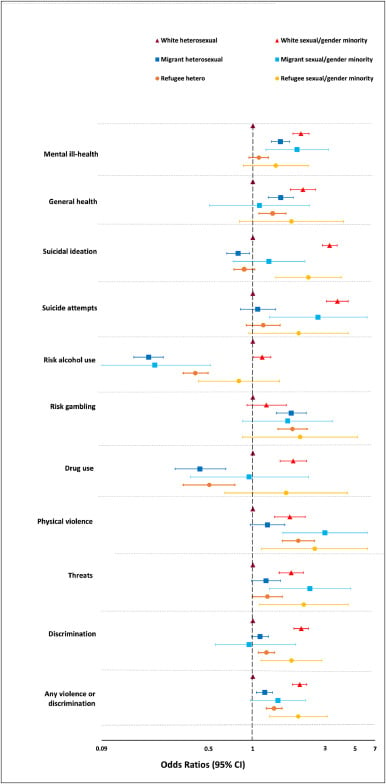
Tables 2 and 3, and Figure 1 display results from regression models. Both White-SGM and EM-SGM had higher odds ratios for poorer general health compared to White-heterosexuals, with the highest odds ratios in the White-SGM individuals. White-SGM (OR 2·15, 95% CI: 1·89-2·44), migrant-heterosexuals (OR1·55, 1·34-1·80) and migrant-SGM (OR2·02, 1·23-3·33) had higher odds ratios for mental ill-health compared to White-heterosexuals. We observed similar results in refugee-heterosexuals (OR1·10 0·94-1·28) and refugee-SGM (OR1·44, 0·86-2·41).

Table 2Associations between sexual/gender and ethnic (including migrant and refugee) identities and binary health and well-being in 157,414 individuals aged 16-84 years from the Swedish National Public Health Survey (2018 and 2020). Estimates are from multiple logistic and linear regression models (models adjusted for sex, age, and educational level).

Text in bold indicates estimates with 95% CI that do not include 1 2 Short version of the Warwick Edinburgh Mental Well-Being Scale (WEMWBS) 3Assessed using the Kessler-6 and GHQ-5 instruments.

Table 3Associations between sexual/gender and ethnic (including migrant and refugee) identities and experiences of violence in 157,414 individuals aged 16-84 from the Swedish National Public Health Survey. Estimates are from multivariable logistics regression models (models adjusted for sex, age, and educational level).

Text in bold indicates estimates with 95% CI that do not include 1.

Figure 1

Figure 1Odds ratios for health and health-related behaviours based on dual sexual/gender and ethnic (migrant and refugee) identities in 168 952 individuals aged 16-84 years who answered the Swedish National Public Health Survey in 2018-20.

Show full caption

Note: Estimates are from multivariable logistic regression models with adjustment for sex, age and educational level.

White-SGM (OR3·39, 3·02-3·82) and refugee-SGM (OR2·42, 1·44-4·08) groups had higher odds ratios for suicidal thoughts compared to White-heterosexuals. All three SGM groups [White, (OR3·84, 3·23–4·55), migrant, (OR2·82, 1·30–6·15), and refugee, (OR2·07, 0·95–4·55)] had substantially higher odds for suicide attempts compared to White-heterosexuals.

In general, ethnic minority (regardless of sexual identity) groups were less likely to report risk alcohol and drug use compared to their White peers. For example, risk alcohol consumption was significantly lower in migrant-heterosexuals (OR0·19,0·15-0·24), migrant-sexual minority (OR0·21,0·09-0·51), and refugee-heterosexuals (OR0·40,0·33-0·49). However, migrants and refugees (heterosexual and SGM) were more likely to report risk gambling.

Experience of different types of violence and discrimination

Compared to White-heterosexual individuals, all other groups had higher odds for experiences of any form of violence or discrimination (for e.g., OR2·11, 1·88-2·36 for White-SGM and OR2·06, 1·30-3·27 for refugee-SGM, Table 3 and Figure 1). Further, White-SGM and refugee-SGM had consistently and significantly higher odds for each form of violence examined separately (physical, threats and discrimination). Migrant-SGM had higher odds for physical violence (OR3·15, 1·61-6·17) and threats (OR2·48, 1·30-4·75) but not discrimination. Migrant- and refugee-heterosexuals also had higher odds for experiences of violence. While migrant-heterosexuals had higher odds for any violence or discrimination (OR1·21, 1·06-1·37), refugee-heterosexuals had higher odds for physical violence (OR2·06, 1·60-2·66) and discrimination (OR1·24, 1·09-1·41).

Sensitivity analysis

Supplementary Tables 4 and 5 display the distributions of all outcomes according to gender and the more detailed sexual identities (heterosexual, homosexual and bisexual identities), respectively. Compared to White cisgender individuals, all other transgender groups had significantly higher percentages of individuals reporting worse general health, mental ill-health (including suicidal ideation and attempts) and exposure to violence and discrimination. In general, greater percentages of bisexual individuals reported mental ill-health compared to their heterosexual and homosexual peers (with the highest percentages observed in the White bisexual group). While all transgender groups had increased odds for risk gambling, the highest odds were observed for refugee transgender individuals (White: OR1·48, 0·66–3·31, migrant: OR1·42, 0·72-2·82 and refugee OR8·62, 1·94-38·40). Transgender individuals also had higher odds for exposure to physical violence compared to cisgender peers (White transgender: OR3·16 (1·86–5·36), transgender migrants: OR6·31, 2·75-14·52 and transgender refugees OR7·46, 2·97-18·70) (Supplemental Table 7).

When examining differences in associations between SGM subgroups, bisexual individuals had the highest odds for mental ill-health and poorer general health [for example OR2·32 and OR1·86 for mental ill-health and OR2·49 and OR1·89 for general health in White-bisexuals and White-homosexuals, respectively, and compared to White-heterosexuals individuals (Supplemental Table 8)]. For migrant and refugee bisexuals vs. homosexuals, the results were mixed. For health and health-related behaviours, migrant homosexuals had higher odds ratios than bisexuals. For example, migrant homosexuals (OR3·25, 0·89-11·83) had higher odds ratios than migrant bisexuals (OR0·36, 0·11-1·22) for drug use. For refugees, we found the opposite. Refugee homosexuals (OR1·39, 0·60-3·23) had lower odds ratios than refugee bisexuals (OR3·82, 1·90-7·68) for suicidal ideation.

Discussion

This study found: 1) White-SGM individuals had consistently higher odds for mental ill-health, poorer wellbeing and general health compared to White heterosexual peers. However, findings were not consistent for EM-SGM individuals. 2) There was a marked difference in the observed pattern for health-related behaviours between White- and EM-SGM groups. 3), Both White and EM transgender individuals had higher odds for exposure to physical violence. White Transgender individuals had higher odds for all adverse health outcomes and all types of violence but not for adverse health-related behaviours. Refugee transgender individuals had higher odds for risk gambling. 4) White bisexuals had higher odds for poorer general health, mental ill-health, and drug use compared to White homosexuals. 5). In general, there were no consistent differences in health and health-related behaviour between migrant and refugee bisexuals and homosexuals

To our knowledge, this is the first study to separately examine health and health-related behaviours in SGM migrant and refugee individuals including transgender individuals in a national population-based sample.

We corroborated earlier research showing that SGM individuals have worse mental and general health compared to heterosexuals both internationally and in Sweden.

13

  • Bränström R
  • Pachankis JE.
Sexual orientation disparities in the co-occurrence of substance use and psychological distress: a national population-based study (2008-2015).

,

38

Mental health of sexual minorities. A systematic review.

It also confirms results from the only study on SM-migrants to Sweden which found that being Nordic-born and SM is a stronger risk factor for mental ill-health including suicidal ideation and attempts than being a migrant and SM. However, this study did not include refugees and asylum seekers, only examined mental health, with a smaller sample that was drawn from a regional cohort.

39

  • Clark K
  • Björkenstam C
  • Kosidou K
  • Björkenstam E.
Psychological distress, suicidal ideation, and suicide attempt among lesbian, gay, and bisexual immigrants: population-based findings from the stockholm public health cohort.

The only other Swedish study to examine mental health in foreign-born individuals residing in Sweden included a sample of 247 SM men, found that country-of-origin stigma was associated with poorer mental health.

40

  • van der Star A
  • Bränström R
  • Pachankis JE.
Lifecourse-varying structural stigma, minority stress reactions and mental health among sexual minority male migrants.

This study did not have a heterosexual comparator group, nor did it distinguish between migrants and refugees.

Existing research shows both better

7

  • Aldridge RW
  • Nellums LB
  • Bartlett S
  • et al.
Global patterns of mortality in international migrants: a systematic review and meta-analysis.

and worse health among EM individuals.

41

Poorer self-perceived health among migrants and ethnic minorities versus the majority population in Europe: a systematic review.

Our findings indicate the complexity of these associations; health, health-related behaviours, and exposure to violence in EM individuals potentially depend on their status as migrants or refugees further compounded by their sexual and gender identities. For example, migrants and refugees were less likely to report risk behaviours (alcohol and drug use) but mental and general health differed by their sexual identity. Refugees as a group have higher risks for poorer health compared to the host population.

8

  • Blackmore R
  • Boyle JA
  • Fazel M
  • et al.
The prevalence of mental illness in refugees and asylum seekers: a systematic review and meta-analysis.

However, our results show that while heterosexual refugees reported worse general health and risk gambling, refugee SGM individuals reported higher odds for suicidality. Importantly, regardless of sexuality, being a refugee is significantly associated with exposure to physical violence and discrimination (also seen in all SGM groups in this study).

Previous studies on refugee SGM individuals showed high rates of mental ill-health and exposure to violence.

24

  • White LC
  • Cooper M
  • Lawrence D.
Mental illness and resilience among sexual and gender minority refugees and asylum seekers.

Our study partially confirms these results (higher odds for suicidal ideation and all types of violence). Unexpectedly we did not find evidence for worse general and mental health. We also corroborate earlier findings that White transgender individuals have poorer health compared to their cisgender peers.

42

  • Dhejne C
  • Van Vlerken R
  • Heylens G
  • Arcelus J.
Mental health and gender dysphoria: a review of the literature.

Few studies investigated refugee and migrant transgender health, but the existing research reports high rates of mental ill-health and experiences of violence but findings are based on smaller non-probability samples.

43

  • Gowin M
  • Taylor EL
  • Dunnington J
  • Alshuwaiyer G
  • Cheney MK.
Needs of a silent minority: mexican transgender asylum seekers.

In this study, we found that transgender refugees have significantly poorer general health, not reported before. A previous study found White transgender youth have a higher risk for problem gambling compared to cisgender youth.

44

  • Rider GN
  • McMorris BJ
  • Gower AL
  • Coleman E
  • Eisenberg ME.
Gambling behaviours and problem gambling: a population-based comparison of transgender/gender diverse and cisgender adolescents.

Our study is the first to report higher odds of problem gambling in refugee transgender individuals. Lastly, our results are in line with previous Swedish studies that showed higher odds for risk alcohol-use and substance use in sexual minority individuals.

13

  • Bränström R
  • Pachankis JE.
Sexual orientation disparities in the co-occurrence of substance use and psychological distress: a national population-based study (2008-2015).

This study benefits from a nationally representative sample with low missing data, and results should be generalizable to the Swedish adult population. The large sample size enabled us to separately examine health in refugee and migrant SM individuals and in sub-groups like bisexual and transgender individuals. Further, the proportions of ethnic and SM individuals who took part in the health survey are similar to the proportions of these groups in the general Swedish population.
Self-reported ethnicity is the ‘gold-standard’ for assessing ethnicity.

46

Migration, ethnicity, race, and health in multicultural societies.

Nonetheless, country of birth is considered a reasonable and often used substitute in the absence of self-identified ethnicity and is widely used in epidemiological studies in Europe.

47

  • Khanolkar AR
  • Sovio U
  • Bartlett JW
  • Wallby T
  • Koupil I.
Socioeconomic and early-life factors and risk of being overweight or obese in children of Swedish- and foreign-born parents.

, 

48

  • Kist JM
  • Smit GWG
  • Mairuhu ATA
  • et al.
Large health disparities in cardiovascular death in men and women, by ethnicity and socioeconomic status in an urban based population cohort.

, 

49

  • Hussen HI
  • Persson M
  • Moradi T.
Maternal overweight and obesity are associated with increased risk of type 1 diabetes in offspring of parents without diabetes regardless of ethnicity.

However, we recognize that using country of birth as a proxy has certain limitations; individuals born in Sweden are categorised as Swedish, even though they may identify as EM. Further, distinct EM groups such as the Kurdish cannot be identified by country of birth. We acknowledge the Swedish- and Western-born group includes individuals who do not identify as White but we nonetheless expect the overwhelming majority in this category to be of White/ European-origin. We had to combine asylum seekers, persons in need of subsidiary protection and refugees in the same group as it is impossible to distinguish these categories of individuals in the dataset. Nonetheless, the distinction between these groups is not always clear and they are often used interchangeably.

50

  • Bradby H
  • Humphris R
  • Newall D
  • Phillimore J

,

51

  • Derluyn I
  • Mels C
  • Broekaert E.
Mental health problems in separated refugee adolescents.

Lastly, the framework (developed in collaboration with the Swedish Migration Agency) to ascertain and distinguish migrant and refugee individuals was robust and used key variables like birth country, migration year, refugee status in high quality national registers alongside historical trends in national migration policy.

Despite the large sample size and population-based design, we had relatively small numbers of individuals who identified as being both EM and SGM, with particularly smaller numbers in the refugee-SM and migrant/refugee-transgender groups. This results in loss of statistical power and affects the precision of some observed estimates (for e.g., the wide confidence intervals related to estimates for transgender individuals). While these estimates would be considered ‘statistically significant’, we advise caution in interpreting the findings. However, our findings indicate overall higher risk for adverse health and experiences in minority groups and highlights the need for larger studies with adequate statistical power. The small number of individuals with dual minority identities also prevented analysis of differences between female and male sexual minorities (Supplementary Table 3) and examining potential non-linear relationships in some outcomes of interest which could have ≥2 categories. We used two different measures for mental health; Kessler-6, and GHQ-5 due to changes in the health survey between 2018 and 2020. Further, while categorization (dichotomizing) of continuous variables like Kessler-6 and GHQ-5 results in loss of statistical power, it facilitates comparison with similar studies as it is common to categorize these variables based on clinically validated cut-offs.

52

The cost of dichotomising continuous variables.

A low response rate, common with national health surveys of this kind is a limitation, but the use of population weights helps compensate for non-response, and the sample remains nationally representative. Lastly, the 2020 survey did not include any questions related to the covid-19 pandemic. There is a possibility that some participants might have been affected by covid-related issues but unfortunately, we cannot ascertain this impact in our study, which needs to be investigated in future studies.

The substantially higher odds for risk gambling in refugee- SGM individuals is a novel finding. Previous reports highlight that risk gambling is more common among migrants in Sweden. There has been an increased interest in health inequalities resulting from gambling-related harm, suggesting that some EM groups have worse outcomes from gambling than others.

54

  • Raybould JN
  • Larkin M
  • Tunney RJ.
Is there a health inequality in gambling related harms? A systematic review.

This is relevant to public health policy as gambling is rarely examined and discussed in studies on refugee/migrant health.

We hypothesized that EM-SGM individuals would have worse health due to the additive effects of two or more minority identities but found limited evidence for this. The few studies that examined health in refugee SGM individuals suggest a cumulative effect of being both a refugee and SGM, but evidence is scarce. Our findings highlight that the problem is likely more complex than a gradient effect and factors other than minority status (for e.g., expectations on equal treatment in society) might affect mental health.

Other explanations include the multiple minority stress model that states stressors associated with being sexual and ethnic minority move through the same pathways.

55

Prejudice, social stress, and mental health in lesbian, gay, and bisexual populations: conceptual issues and research evidence.

This model hypothesizes that poorer health outcomes in individuals with one or more minority identities results from multiple and repeated exposures to stigma, discrimination and microaggressions. This may explain the observed higher odds for violence and discrimination found in all minority groups including the White-SM, EM-heterosexual and dual minority groups in this study.

Further, these findings were more pronounced in transgender individuals. However, our results cannot only be explained by the cumulative effects of minority identities. For example, White SGM had worse mental and general health, suicidality, and risk alcohol and drug use compared to dual minority individuals, which contradicts the additive effects of more than one minority identity on health. Earlier studies showed that some pathways leading to mental ill-health in refugees and migrants include social exclusion, isolation, inability to access the labour market, and exposure to discrimination in the host country.

56

  • Matlin S.A.
  • Depoux A.
  • Schütte S.
  • et al.
Migrants’ and refugees’ health: towards an agenda of solutions.

This could potentially explain some of our results as the EM-SGM group are potentially more exposed to a greater burden of discrimination associated with their ethnicity and sexuality leading to poorer health, compared to heterosexual peers. These mechanisms can be appropriately investigated in longitudinal data which is currently unavailable in Sweden.

The intersectionality framework theory is another potential and often cited explanation for adverse health in individuals with multiple minority identities.

27

The problem with the phrase women and minorities: intersectionality—an important theoretical framework for public health.

,

28

  • Bauer GR
  • Churchill SM
  • Mahendran M
  • Walwyn C
  • Lizotte D
  • Villa-Rueda AA.
Intersectionality in quantitative research: a systematic review of its emergence and applications of theory and methods.

This framework theory helps understand how unique and multiple social identities (like ethnicity, gender, sexuality, faith belief etc.) intersect at the individual-level, reflecting various multiple and reciprocal systems of discrimination that impact health in individuals with ≥2 minority identities.

27

The problem with the phrase women and minorities: intersectionality—an important theoretical framework for public health.

,

28

  • Bauer GR
  • Churchill SM
  • Mahendran M
  • Walwyn C
  • Lizotte D
  • Villa-Rueda AA.
Intersectionality in quantitative research: a systematic review of its emergence and applications of theory and methods.

Thus, each individual experiences their own unique forms of discrimination and oppression associated with their identities. These social identities are not isolated from one another or simply additive but are interdependent and mutually constitutive, i.e., they should be examined jointly to better understand the interdependence of minority identities. In Sweden, research has primarily examined health associated with one minority identity (most often ethnicity) and disregarded the potential impact of intersecting multiple minority identities. The intersectionality theory can explain some of our results, including contradictory findings. Minority groups may be differently impacted based on their unique intersecting minority identities and the environments they live in, including the host country’s policies. For example, while White-SGM individuals had increased risk for all adverse health-related behaviours except risk gambling, the opposite was observed in EM-SGM individuals. This could reflect differences in coping mechanisms and/or recreational activities intrinsically associated with unique identities. White-SGM individuals are more likely to report excessive alcohol and drug use, often a coping mechanism to deal with discrimination and stress associated with being SGM,

12

  • Marshal MP
  • Friedman MS
  • Stall R
  • et al.
Sexual orientation and adolescent substance use: a meta-analysis and methodological review.

,

57

  • Kalb N
  • Gillis R
  • Goldstein A.
Drinking to cope with sexual minority stressors: understanding alcohol use and consequences among LGBQ emerging adults.

and non-White individuals potentially use other forms of more culturally accepted coping mechanisms like gambling. Lived experiences and their intrinsic associations with unique identities and consequences on health can be further impacted by wider society and the host country’s health policies. Currently, Swedish policies on gambling are more general without any specific guidelines related to ethnic and/or sexual identities and our results suggest that this might be relevant in future policies.

Migrant and refugee individuals who may have experienced terrible events in their home countries (for example, discrimination associated with SGM identities or experiences related to war/conflict), might feel relieved and safe after arrival in a host country. This differs from individuals who grow-up and live in a country like Sweden with liberal SGM rights but still experience discrimination, which can lead to disappointment and depression.

We hypothesize that the exposure of interest i.e., ethnic and sexual identities is conceptualized within individuals before the occurrence of outcomes (i.e., temporality). Nonetheless, as this is a cross-sectional study, we do not interpret findings as an indication of causality. This highlights the need for longitudinal data on individuals with self-identified ethnicity and sexuality which currently does not exist in Sweden.

To conclude, we found White SGM individuals reported worse health and were more likely to engage in risk behaviours in Sweden. These associations differed in migrant and refugee SGM groups. Access to care is already difficult for migrant and refugee individuals and SGM minorities.

58

  • Satinsky E
  • Fuhr DC
  • Woodward A
  • Sondorp E
  • Roberts B.
Mental health care utilisation and access among refugees and asylum seekers in Europe: a systematic review.

,

59

  • Alencar Albuquerque G
  • de Lima Garcia C
  • da Silva Quirino G
  • et al.
Access to health services by lesbian, gay, bisexual, and transgender persons: systematic literature review.

Barriers include language (inability to speak Swedish), stigma, low awareness and different help-seeking behaviours in refugees

58

  • Satinsky E
  • Fuhr DC
  • Woodward A
  • Sondorp E
  • Roberts B.
Mental health care utilisation and access among refugees and asylum seekers in Europe: a systematic review.

and heteronormative attitudes towards sexual minorities.

59

  • Alencar Albuquerque G
  • de Lima Garcia C
  • da Silva Quirino G
  • et al.
Access to health services by lesbian, gay, bisexual, and transgender persons: systematic literature review.

There is thus good reason to assume that this access and use of care might be even lower in SGM migrants and refugees. Hence, there is need for more research and practices into increasing access to care for this population as well as developing interventions specifically tailored to meet their needs. To be able to fully investigate these differences in the future more detailed data sets including ethnicity and sexual and gender minorities are warranted. Future public health policy needs to address existing barriers such as improving access to healthcare services and training of professionals including being made aware of difficulties faced by SGM individuals. A specific focus should be on risk gambling. Further, preventive measures to reduce exposure to violence and discrimination in both SGM- and EM-groups. Finally, there is a need to involve SGM groups in informing public policy since their views on these health disparities are often not considered.

[ad_2]

Source link

Tagscolordesignfamilygaygoldgoodhealthhomeindialifelivememodelthailandtrainingusawhitewomenworkworld
Previous Article

Opinion divided in WEA education lawsuit | ...

Next Article

Best Labor Day Fashion, Beauty, and CBD ...

0
Shares
  • 0
  • +
  • 0
  • 0
  • 0

Related articles More from author

  • Health & Beauty

    Health Equity: The Current Environment and Paths to Improvement

    September 26, 2022
    By admin1
  • Science & Tech

    University of Utah Announces New Climate Science Policy Center with $20 Million Endowment

    August 24, 2022
    By admin1
  • Fashion

    Burberry and Raf Simons cancel London Fashion Week shows in ‘mark of respect’ for Queen

    September 9, 2022
    By admin1
  • Science & Tech

    Jobs summit could catalyze quantum shift in science and research

    August 16, 2022
    By admin1
  • Science & Tech

    Vernier Software & Technology is now Vernier Science Education.

    August 17, 2022
    By admin1
  • Travel & Lifestyle

    Rethinking Education in Bosnia and Herzegovina: The Resident Coordinator’s Blog |

    September 16, 2022
    By admin1

You may interested

  • Science & Tech

    How to Edit iPhone Lock Screen in iOS 16

  • Science & Tech

    CBRE Investment Management to Purchase Life Sciences Campus for $288 Million – Commercial Property Executive

  • Science & Tech

    Pecan AI Jumps Over Skills Gap to Enable Data Science On Demand

Search

Categories

  • All (1,224)
  • Books & Novels (2)
  • Buying Guides (22)
  • Buying Guides (20)
  • Donation and Services (1)
  • Export Test (21)
  • Fashion (1,489)
  • Gift Guides (37)
  • Gift Guides (20)
  • Health & Beauty (1,384)
  • Health & Beauty (8)
  • Home&Living (55)
  • Mobility & Lifestyle (2)
  • Non classifié(e) (2)
  • Science & Tech (1,334)
  • Sports (12)
  • Technology (52)
  • Travel & Lifestyle (1)
  • Travel & Lifestyle (1,407)
logo

Goevry is not just another run-of-the-mill magazine; it's a transformative journey that transcends the boundaries of traditional fashion publications. Our team of passionate experts, seasoned fashionistas, and visionary writers collaborate to curate a diverse range of thought-provoking features that delve into the very essence of style, culture, and identity.

  • Recent

  • Popular

  • Meshki Cotton Dresses: The Ultimate in Comfort and Fashion

    By admin1
    November 29, 2024
  • FUNNYFUZZY Sofa Covers: Comfort, Style, and Waterproof Durability

    By admin1
    November 29, 2024
  • A Homecoming Story, An Original Documentary Featuring Giannis Antetokounmpo

    By admin1
    January 17, 2024
  • Detroit native Sharyl Kloss finds her truth in fashion

    By admin1
    September 23, 2022

Follow us

  • DMCA
  • Privacy Policy
  • About Us
  • Contacts
©2024 Copyright Goevry | All Rights Reserved.
We use cookies to ensure that we give you the best experience on our website. If you continue to use this site we will assume that you are happy with it.OkPrivacy policy