‘The Sound of Molecules’ mixes science and music in WonderLab’s show
[ad_1]

Do a remi, x-ray, MRI. Are molecules simultaneously scientific and musical? WonderLab answers yes.
What do molecules sound like? Others have done research on molecular sound, but college undergraduate Walker-Smith is presenting his show “The Sound of the Sound” at the WonderLab, a science museum in Bloomington. The Sound of Molecules” analyzes and hums complex facts to enlighten audiences of all kinds.
Smith’s chemistry class lecture notes have turned into musical notes. Since his ninth grade, Smith, a chemistry and music student at Indiana University, has sought to musically represent chemistry by turning his research into music. And he has continued to be dynamic and fun while maintaining his scientific integrity. WonderLab will host his ‘The Sound of Molecules’ on his 17th and 18th of September for his fourth time.
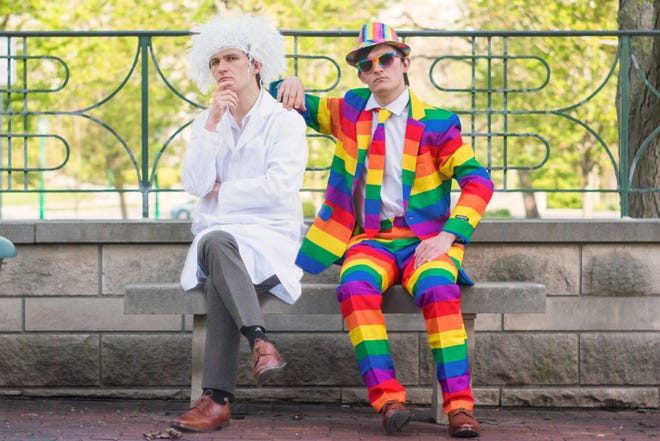
After studying electronic music at IU while also learning about scientific research, presentation, and composition, Smith honed his science and music shows. He also stars as two characters on the show.
Adapt your show to WonderLab
WonderLab was just one of the venues hosting Smith’s 45-minute program, which was tailored for WonderLab’s specific audience. Music, lasers, chemistry, and jokes are educational and entertaining. The creators of the show, Smith (with generous support including funding and mentorship from individuals and organizations), Maestro Molecules and Roy G. Biv (rainbow red, orange, yellow, green, blue, indigo, like purple).
The maestro molecule opens the show. Roy G. Biv is his excellent student. Whereas Maestro is obsessed with the kind of light that the human eye can’t see, Biv extols his love of color, the light we can see.
thoughts on light and sound
As Smith shaped the idea of science and music, he said on the phone:
At IU, Smith studies both organic chemistry and composition, using nuclear magnetic resonance techniques in which large magnets probe the nuclei of atoms to analyze molecules. Chemists use light spectra to learn about molecules. But Smith saw another spectrum: a connection to sound.
According to science.nasa.gov, the human eye can see wavelengths in the “visible” portion of the electromagnetic spectrum. All electromagnetic radiation is light. But humans can only see part of it. Each color has a different wavelength, with red being the longest and violet being the shortest.
Regarding spectroscopy, which examines the electromagnetic spectrum, wavelengths, electromagnetic radiation, and matter, Smith says:
Think of a medical MRI machine. According to Smith, MRI machines use regions of the electromagnetic spectrum that humans cannot see. Think also about X-rays. X-rays interact with matter to provide images of bones, he said. “X-rays can tell us the skeleton of a molecule.”
Combining his three passions (communication, composition and chemistry), Smith achieves the “three C’s triangle”.
“Walker-Smith is one of the most innovative Jacobs School of Music students I have ever met,” said Alan Barker of the Center for Rural Engagement, an expert in music entrepreneurship and career development. I am a director. “[Smith’s]project is now drawing support from IU’s Rural Engagement Center, which will allow us to create and share projects in schools in rural communities. Walker and Dr. Molecules have a big future. is waiting!”
A bridge between STEM and the arts
Alex Tedrow, Smith’s colleague on other projects, said “(Smith) is brilliant and his (‘Sound of Molecules’) project is very innovative.” Tedrow is pursuing a Master of Science in Composition and Musical Education and a Master of Science degree at the IU Jacobs School of Music. Regarding Smith’s current project, Tedrow said: evident in much of his K-12 curriculum. ”
Tedrow says Smith’s Musical Molecules project lets students who aren’t interested in science find a fascinating connection between their love of music and technology. Tedrow, on the other hand, hopes this will encourage STEM students to explore similarities between fields of study in the arts, culture, humanities, and sciences.
“Because of our specialization, we tend to forget that there are many beautiful connections that naturally exist in our world, but Walker’s project brilliantly brings those connections to life in a truly tangible way. I think you are letting me.”
Who is Creator Walker Smith?
Smith is the winner of the 2022 Annual Project Jumpstart Innovation Competition hosted by the IU Center for Rural Engagement and the Johnson Center for Entrepreneurship & Innovation at The Kelly School. Last year he won a Goldwater Scholarship. This is a prominent US gift in honor of soon-to-be mathematicians, scientists, and engineers. After that, he worked as an intern at Eli Lilly in Indianapolis.
After graduation, Smith plans to pursue a Ph.D. in organic chemistry.
if you go
what: The Sound of Molecules: A melodic science show about sound at the molecular level. It showcases the fun and educational aspects of creator Walker Smith’s research while also demonstrating that it meets science standards in the classroom.
when: September 17, 11am-noon and 4pm. September 18, 2-3pm, 4pm
Where: WonderLab Museum of Science, Technology, and Health, 308 W. Fourth St.
tickets: Admission to the museum is free for scientists, parents, teachers and children of all ages. General admission is $14, and children under 1 are free.
more: The Sound of Molecules show is made possible through partnerships with WonderLab, the Indiana University Center for Rural Engagement, and the Indiana University Jacobs School of Music. For more information about WonderLab, visit wonderlab.org or WonderLab’s Facebook page.
[ad_2]
Source link