IU Health Opens One of Indiana’s Largest Home Health Centers

[ad_1]
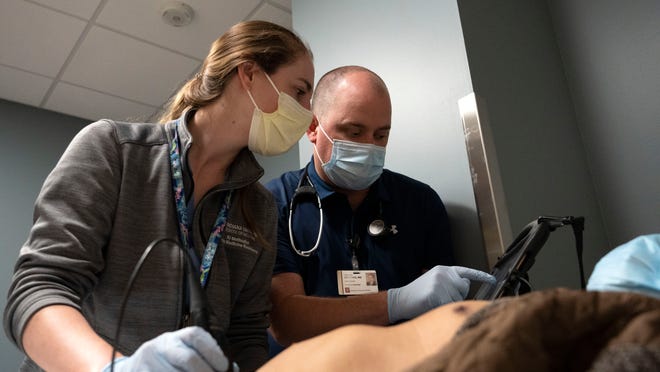
IU Health has opened a $10 million state-of-the-art outpatient and family medicine center on the site of the former Wishard Hospital emergency room near Indiana Avenue and 10th Avenue.
This need arose when the old medical center on Senate Street was demolished to make way for the new IU Health Hospital on the medical campus in downtown Indianapolis.
The IU Health Family Medicine Center (1040 Wishard Blvd.) serves over 60 providers while serving patient needs. With over 40 physicians in training, IU School of Medicine runs the largest family medicine residency program in the state.
Here’s what you need to know about the center, which opened in July.
New IU Medical Center Has Plenty of Space
At over 46,000 square feet across two floors, the center is almost twice the size of its predecessor. The previous center opened when he had 18 residents in the family medicine program.
The new center now has more than double the number of physicians, making it one of the largest family practices in the state, said Deanna, family physician and vice chair of research and family medicine at IU Health. Dr. Willis said.at the Indiana University School of Medicine.
The center serves more than 15,000 patients annually, approximately 40% of whom are on Medicaid. Health officials at IU do not expect a dramatic increase in the number of patients they serve at the new center, but the extra space will give them flexibility should they see an influx of people in need of care. We can handle it.
Novel clinic design has a central working room for healthcare providers
The clinic consists of four pods, each with approximately 12 patient examination rooms around a large healthcare provider workroom.
All examination rooms have two doors. One is away from the patient drop-off hallway and the other leads to the provider’s room. There are 48 hospital rooms in total, one of which can be used for procedures.
These “doughnut-shaped” pods, with a provider room “hole” in the middle, reduce patient corridor traffic and keep all providers working in that pod room in one space. to facilitate communication between staff.
Clinic design improves patient privacy
The new design enhances patient privacy as medical staff are not congregating in hallways, allowing patients to walk by the computer and view other patients’ medical records. Congestion in the hall will be eased, making it easier for patients to commute.
Patients notice a big difference
Upon their first visit to the new facility, Maurice Saunders, 46, and her caregiver Yolanda Smith noticed a difference. Sanders has been attending clinics for the past two years for treatment of diabetes, chronic obstructive pulmonary disease and high blood pressure.
The new facility is much more accessible for patients like Sanders, who use wheelchairs, because the rooms are much larger.
“I love that the doctors and nurses are coming from that edge,” Smith gestured toward the door from the examination room that leads to the health care provider’s workroom. “It feels more private.”
Central provider rooms improve communication
From a provider’s point of view, the pod concept helps reduce the distance a provider has to walk when moving from room to room.
Older spaces may require walking across the often crowded clinic, Willis said.
The design aspect proved to be a boon for providers, but it took some time for open workspaces to catch on.
It was a minor adjustment. Everyone will be in the same space,” he said. “Other places have shown this to work.”
By bringing everyone together in the same place, shared spaces spark more conversation between residents and faculty, said family medicine resident Dr. Molly Rettinger.
“There is more learning because everyone is there at the same time,” she said. “I think this is a big step up.”
Models may improve care
When clinic officials began to consider what they needed for the new space, they looked elsewhere for a model closer to their vision. Willis said they liked the approach used at Creighton University..
The Creighton University professor showed in a published paper that the highest-risk patients had fewer hospitalizations and emergency room visits after implementing the model.
Once Willis and his colleagues identified what they wanted to do, they had to find a place where they could do it.
“It was a very innovative design,” said Willis. “There aren’t many buildings designed with a donut space in the middle, so we were lucky to have this shell-shaped space.”
Please contact Shari Rudavsky at shari.rudavsky@indystar.com. Follow her on her Twitter: @srudavsky.
[ad_2]
Source link