James Webb’s First Two Months of Science Highlights
[ad_1]
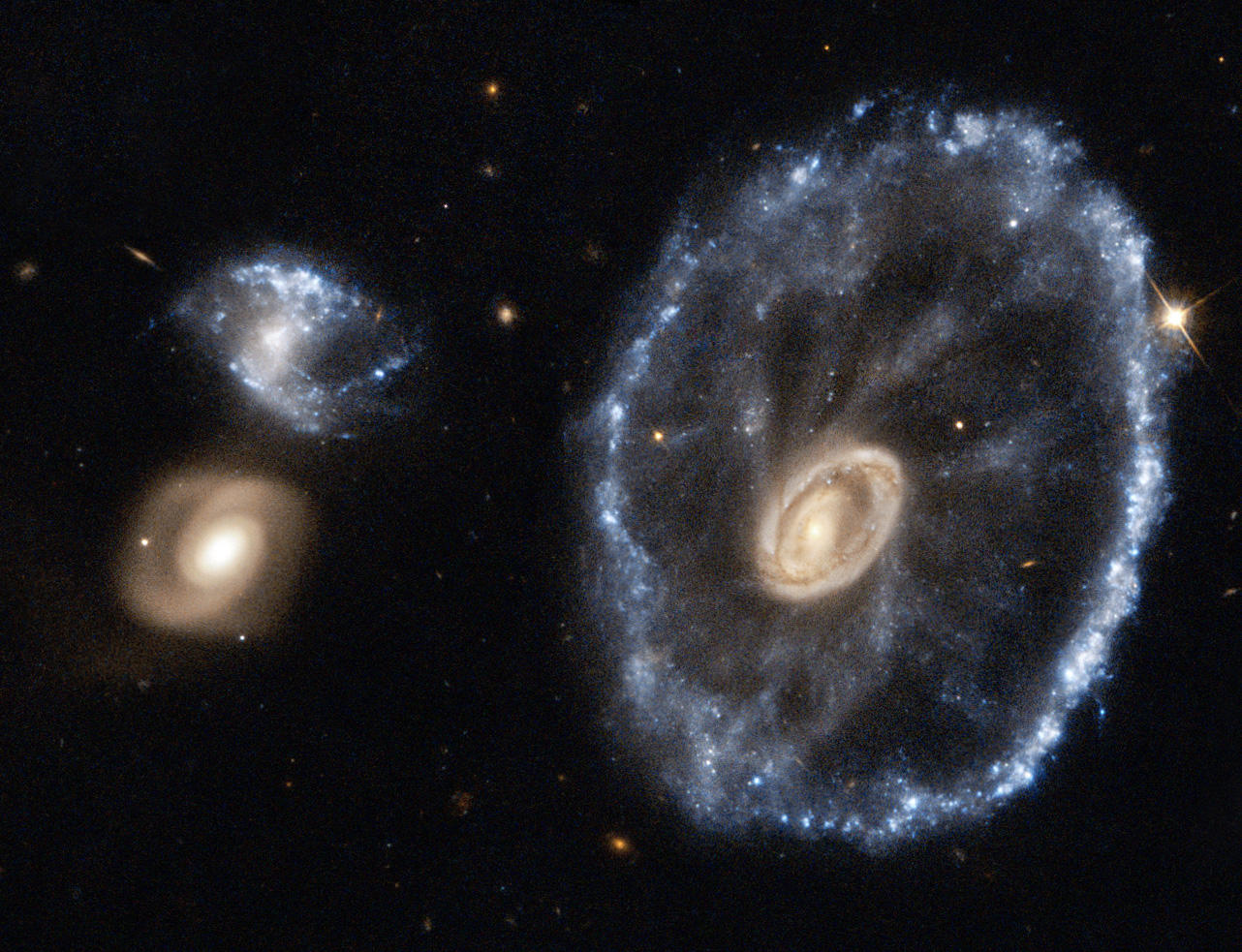
Historically, the most spectacular views of deep space have come from Hubble.

The cartwheel galaxy, shown to the right, is a stunning example of an imperfect ring galaxy, with a core of old stars and a bright ring of young stars connected by thin bridges of gas and stars. The cause of this ring, the crossed galaxy that crashed through the cartwheel, is in the image’s upper left and is itself forming new stars as a result of its interaction.
But as of July 2022, we have a better space telescope.

This near-infrared image from JWST shows various features present in cartwheel galaxies and their relatives that cannot be revealed by Hubble. Due to Hubble’s small size, low resolution, high temperature, and poor instrumentation, JWST’s unique capabilities reveal features of almost any object that has never been seen before.
The James Webb Space Telescope (JWST) gives us something we’ve never seen before.

This image features data from 10 different JWST filters. Six are from the near infrared and four are from the mid infrared. As a result, features including stars, gas, dust, and various molecular features can all be revealed at once, revealing, among many other features, where star formation is occurring and will occur in the future. I can show you the location.
Jupiter appears nearby in a form never seen before.

This three-filtered view of planet Jupiter from JWST’s NIRCam features a 3.6 micron (red) channel, a 2.12 micron (yellow green) channel, and a 1.5 micron (blue) channel. All these wavelengths are best aligned and combined to account for the planet’s rotation to reveal the unusual features seen here.
Its bands, rings, aurora, and moon appear with the galaxy in the background.

This animation showcases JWST’s unique near-infrared view of Jupiter. In addition to the band, the Great Red Spot, and the “atmospheric haze” visible at Jupiter’s day/night boundary, numerous lunar, ring, and auroral features are seen and labeled. Note that various faint “dirts” can be seen farther from the planet. These are distant background galaxies, rarely seen in the same frame as bright planet-like objects, but JWST’s superior optics can reveal them.
JWST directly observed exoplanets in infrared images.

A gas giant exoplanet orbiting around the star HIP 65426, which JWST hides in its high-contrast coronagraph, has been revealed. A combination of two near-infrared filters and two mid-infrared filters can reveal this planet. This planet is about 10,000 times fainter than the star it orbits.
Spectroscopically, transit detects absorbed light

Instead of blocking the same portion of the star’s light at all different wavelengths, transiting exoplanets absorb and transmit different portions in a wavelength-dependent manner. Just as Earth’s atmosphere preferentially transmits red light and scatters blue light, exoplanet WASP-39b allows different fractions of light to pass through its atmosphere in a wavelength-dependent manner that JWST can detect. to
and transmitted light: reveal the presence of molecules.

In its first scientific publication, JWST revealed the spectroscopic presence of water in the atmosphere of an exoplanet. Measurements by WASP-39b have revealed that the exoplanet’s atmosphere is rich in carbon dioxide. Undoubtedly, more molecules with varying concentrations will be discovered in different worlds using JWST.
Star-forming nebulae display unprecedented detail.

The near-infrared view of the Tarantula Nebula taken by JWST has higher resolution and wider wavelength range than any previous view. Extending what Hubble taught us, we can now study star formation in greater detail than ever before without local groups.
From a new, young, blue star,

The center of this young star cluster at the center of the Tarantula Nebula is known as R136 and contains many of the most massive stars known. Among them is R136a1, which is about 260 times the mass of the Sun and is the most massive star known. Overall, this is the largest star-forming region within our local group and will likely form hundreds of thousands of new stars.
The characteristics of gases are

As spectroscopic imaging by JWST reveals, chemicals such as atomic and molecular hydrogen and hydrocarbon compounds occupy various locations in space within the Tarantula Nebula, even in a single star-forming region. shows how diverse the
JWST shows that Hubble cannot.

This animation shows the transition between the near-infrared view of JWST showing new stars and light-absorbing dust, and the mid-infrared view where the warm dust is illuminated and the stars are virtually invisible. These views go far beyond what Hubble was able to see, and take us into unprecedented realms of wavelength and resolution.
On the other hand, JWST’s initial alignment images have grown tremendously.

The JWST diffraction spike seen in great detail around star 2MASS J17554042+6551277 is the same spike seen in the first successful alignment image. The scientific data are finally being used, as evidenced by the stunning detail of the background galaxy.
Now with a view of over 140 megapixels, it reveals a wide range of distant galaxies.

This small-looking image is a scaled-down version of the field of view up to 140 megapixels that was comprehensively examined after the JWST was perfectly aligned and calibrated. The bright star in the bottom left of the picture is the famous “alignment star” of the first aligned image of JWST.
Only 1% of this view contains up to 100 identifiable objects.

This is a full resolution view of just 1% of the field used to capture the star 2MASS J17554042+6551277, which served as the JWST’s first alignment target. About 100 galaxies are revealed here, indicating that there are about 10,000 galaxies and should be visible to the JWST over the full image field of view.
Massive, evolved and complex galaxy shapes appear at all observed distances.

Early results from the GLASS Early Release Science program reveal over 200 sources across a range of redshifts and masses. This tells us what shapes galaxies take at different masses and stages of cosmic time/evolution, and we can see many galaxies that are very massive, very early, yet very evolved. I will clarify.
Furthermore, a candidate for a disk galaxy appears unexpectedly very early on.

The Cosmic Evolution Early Release Science Survey (CEERS Survey) broke the record for the largest deep-field image taken by JWST, previously held by the first lens cluster image released. This small patch of sky near the handle of the Big Dipper contains about 200 candidate bright disk galaxies found within the first ~3 billion years of the universe’s history. This is a surprisingly early time, but it provides many lessons about galaxy formation and evolution.
JWST also saw the most distant star ever, Earendel.

This view of Arendelle, the most distant star currently known, is courtesy of JWST. The eight NIRCam filters that observed this star most likely indicate that it is a single star, approximately 1,000,000 times brighter than the Sun, with a surface temperature of approximately 15,000 K and a lens magnification of at least 1x. I was able to determine that. 4,000. Follow-up observations, including spectra, are scheduled for the second half of 2022.
But, arguably, its largest images are of individual galaxies.

Spiral galaxy NGC 7496, previously observed by Hubble, details a surprising amount of illuminated dust lanes, massive feedback from new stars, and the early stages of star formation throughout the galaxy. With JWST, you can see the universe in more detail than ever before.
JWST view revealed gas, dust and starsmore.

This view of the gas, dust, stars, and more within galaxy NGC 1365 was kindly provided by JWST and the PHANGS team, which investigates the detailed characterization of dust-rich star-forming galaxies. Images like these help us understand how and where stars form throughout the life of the galaxy.
The core, which contains the central black hole, glows in mid-infrared light.

This mid-infrared (MIRI) view of bright infrared galaxy VV 114, shown alongside an old Hubble view, reveals a bright nucleus in the eastern part and a western component rich in young star clusters. The presence of an active galactic nucleus is revealed in the southwestern part of the eastern region, with about 40 star-forming knots, about 10 of which have no optical counterpart. The presence of polycyclic aromatic hydrocarbons is also seen.
Star-forming gas bridges appear between interacting galaxies.

The galaxy IC 1623B is displayed in various near-infrared filters using JWST, revealing details about the interstellar medium between two active, interacting, star-forming galaxies. These NIRCam images represent only a portion of the total data including NIRSpec and MIRI images acquired for this galaxy.
from Hubble,

This view of the Phantom Galaxy, also known as Messier 74/NGC 628, combines blue, visible, and near-infrared images from Hubble with the specific emission lines of hydrogen that make up this composite. This was the best previous view of the Phantom Galaxy and revealed many interesting features, but JWST’s view already reveals a lot.
JWST’s near-infrared eye,

This pure infrared view of the phantom galaxy Messier 74 shows cooler stars and the complex dusty structures found inside and between the galaxy’s spiral arms. These structures were only suggested in previous views. A unique feature of JWST reveals them for the first time.
In the unfamiliar and eerie mid-infrared scenery,

Taken with JWST, this mid-infrared view shows a phantom galaxy (M74) with prominent, well-defined spiral arms. Overall, the PHANGS collaboration will study 19 nearby star-forming galaxies to better understand when and how star formation is triggered, and in the process determine the mass and age of the star clusters within them. measure.
The universe comes into focus under Webb’s watchful eye like never before.

This three-panel animation shows three different views of the center of the phantom galaxy M74 (NGC 628). The familiar color image is the Hubble (optical) view, the second panel shows near-infrared views from both Hubble and Webb, and the mid-infrared panel shows warm dust that eventually forms new stars. JWST alone.
Primarily, Mute Monday tells an astronomical story with images, visuals and 200 words or less. don’t talk too much laugh more
[ad_2]
Source link